
Thirteen Ways of Looking at a Blackbird by Wallace Stevens (1954)
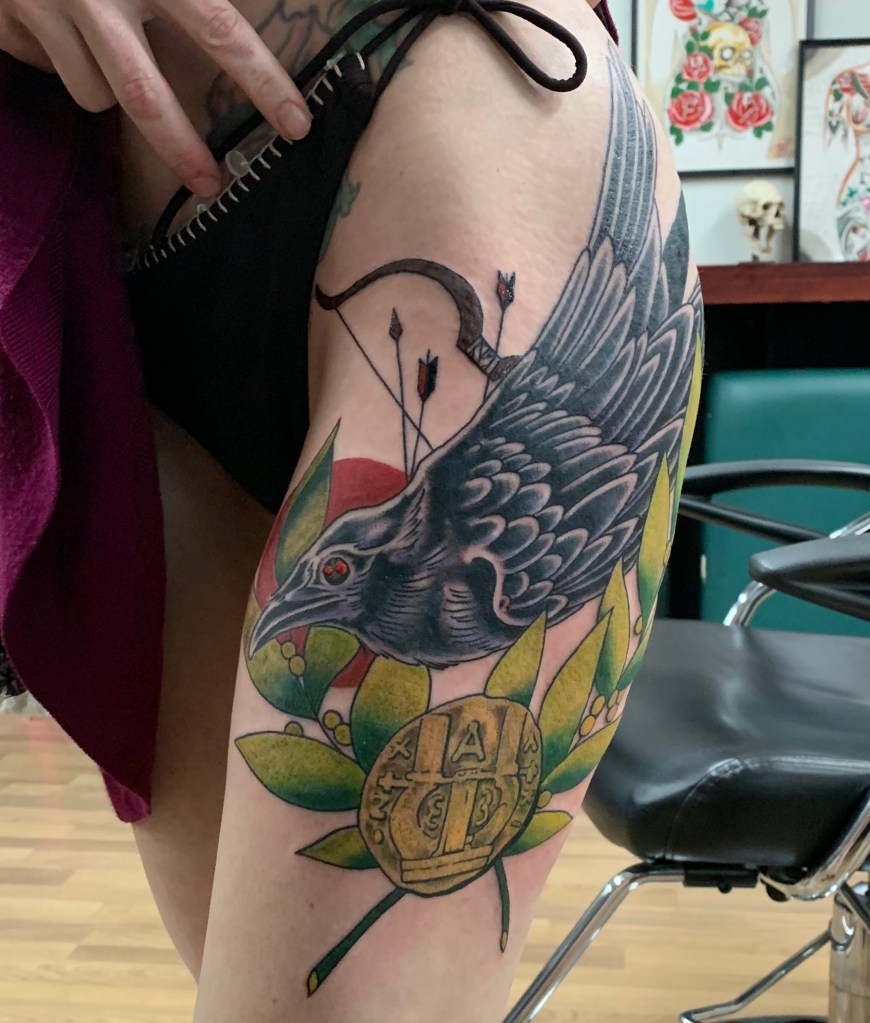
My two big tattoos (no jokes about my thighs, please) are a diptych representing the Apollonian/Dionysian conflict. On my left, we have Apollo, and on the right, his brother Dionysus. Apollo, god of the sun, is one noble dude. He’s thoughtful and reasonable. He fills out his planner, and, in doing so, never forgets a birthday. Dionysus is the god of wine and dance. He’s the life of the party, a little chaotic. Maybe he has a planner, but it’s only full of doodles of boobs. Your birthday is NOT in it, but he’s at your party. (I may have committed a little too heavily to this metaphor.)
This conflict is rife in the arts because I think we can agree that we’ve all got a combination of Apollo and Dionysus in us. It is not representative of good versus evil: there’s a plurality to human nature that is more complicated than the devil on one shoulder and the angel on the other. Both of these brothers are the devil and both are the angel, and we center ourselves by finding balance between and within them.
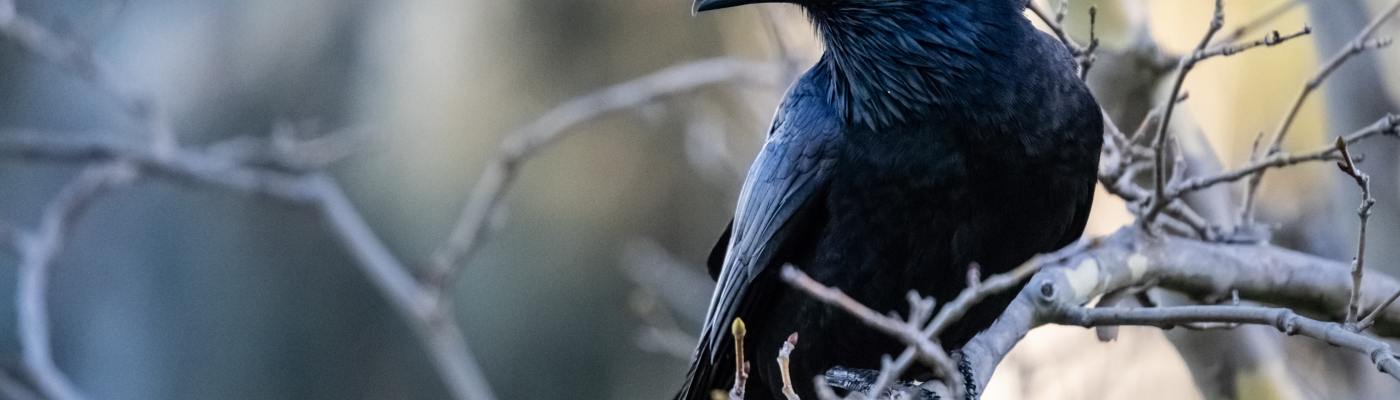
Stevens’s poem isn’t directly about Apollo or Dionysus, but it is a striking example of this dichotomy. There are thirteen very short stanzas that create haunting tableaux, culminating in a work that encapsulates life and death, dark and light, movement and stillness, order and chaos. Watch how the blackbird follows you through the poem, then be sure to invite it to your birthday party.
Short Stuff:
- This poem is featured in Tiff’s and my novel!
- If you find yourself in Hartford, Connecticut (let’s be real, we all eventually end up there), you can find all 13 stanzas carved in granite stones along the Wallace Stevens Walk..
Topics in this poem:
the passage of time; perspective; nature; all that conflict stuff
Thirteen Ways of looking at a black bird
I
Among twenty snowy mountains,
The only moving thing
Was the eye of the blackbird.
II
I was of three minds,
Like a tree
In which there are three blackbirds.
III
The blackbird whirled in the autumn winds.
It was a small part of the pantomime.
IV
A man and a woman
Are one.
A man and a woman and a blackbird
Are one.
V
I do not know which to prefer,
The beauty of inflections
Or the beauty of innuendoes,
The blackbird whistling
Or just after.
VI
Icicles filled the long window
With barbaric glass.
The shadow of the blackbird
Crossed it, to and fro.
The mood
Traced in the shadow
An indecipherable cause.
VII
O thin men of Haddam,
Why do you imagine golden birds?
Do you not see how the blackbird
Walks around the feet
Of the women about you?
VIII
I know noble accents
And lucid, inescapable rhythms;
But I know, too,
That the blackbird is involved
In what I know.
IX
When the blackbird flew out of sight,
It marked the edge
Of one of many circles.
X
At the sight of blackbirds
Flying in a green light,
Even the bawds of euphony
Would cry out sharply.
XI
He rode over Connecticut
In a glass coach.
Once, a fear pierced him,
In that he mistook
The shadow of his equipage
For blackbirds.
XII
The river is moving.
The blackbird must be flying.
XIII
It was evening all afternoon.
It was snowing
And it was going to snow.
The blackbird sat
In the cedar-limbs.
—Wallace Stevens
 stuckandmericle.com
2 thoughts on “Day 6: Thirteen Ways of Looking at a Black Bird by Wallace Stevens”