No Possum, No Sop, No Taters by Wallace Stevens (1943)
Like I said, I don’t have a favorite poet. But if I did, it would be Wallace Stevens. So yeah, he gets two poems this month.
Why? Well, Thirteen Ways of Looking at a Blackbird has such an enormous place in my heart, what with the inclusion in Tiff’s and my book and all the Apollonian/Dionysian conflict stuff. And this one has an enormous place in my soul. I cannot read it without whispering some of the lines out loud. OH MY GOD “like seeing fallen brightly away”. Who says that????
I’m gushing.
For the most part, I’ve done very little analysis in these write-ups. I hesitate to publicly analyze poetry for lots of reasons, mostly because I feel like I’m probably wrong. I’m an English teacher, but I’ll let you in on a little secret: I have serious issues with reading comprehension. All the reading strategies I teach to my kiddos have gone through the gauntlet of my own brain, and I use them constantly. If I read something casually, without the support of all my available tools, I don’t understand it, or worse, I actively misunderstand it. Hence, hesitation.
I also don’t think we can ever be too sure about what a writer (or any artist) means. There are examples ad nauseam of creators coming out to say,
“That is not what I meant at all;
That is not it, at all.” *
BUT I still think it’s important to analyze poetry. It’s why I like Tarot readings, even though I don’t believe they are fueled by any mystical power. I see them as an outside source of perspective-shift, a way to examine aspects of my life through a different lens.
Analyzing a poem offers a similar lens. It forces me to look closely, and that’s usually when I make my breathless discoveries, both of the craft and of its meaning. And art can mean what you, what I, need it to mean.
Thus, with those caveats, Imma go ahead and do some analysis on this puppy. Feel free to skip to the poem, or to read it first and come back.
*Yeah, you got EliotRolled! Let’s make this a thing!
A Probably Wrong and Definitely Too Brief Analysis:
First up: the title. What’s up with the title, which seems so at odds with the rest of the poem? It brings up images of simplicity, maybe even poverty. But possum, sop, and taters also have a down-home, earthy sense of comfort, right? So at the onset, Stevens is telling us that those comforts are missing. Gone. Zilch. Ain’t no possum, sop, or taters here, move on if you dare.
Then we get a sense of place and time, with a personification of the sun, who is old, and who is also absent. Again, the warmth is gone. But note, the sun is gone not as if he were asleep, but as if we were. So the sun is personified while we are asleep, all in this place that lacks any warmth. Bummer.
As if to affirm our suspicions, his second stanza tells us flat-out that the field is frozen. Now we are asleep in a world that is frozen due to an absent sun. (And yes, Stevens was skeptical about God but awfully curious about spirituality, so feel free to run with this if you want.) And then we get, for me, the first chill-inducing line of the poem: “Bad is final in this light.” It’s final. It’s complete. It’s perfect. Nowhere else for it to go from here. We have arrived.
I find it interesting that he uses the adjective ‘bad,’ instead of a noun. What this indicates to me is the pervasiveness. If it were ‘badness,’ not only would that sound silly, but it would feel contained to one specific concept. As an adjective, it can be applied to anything.
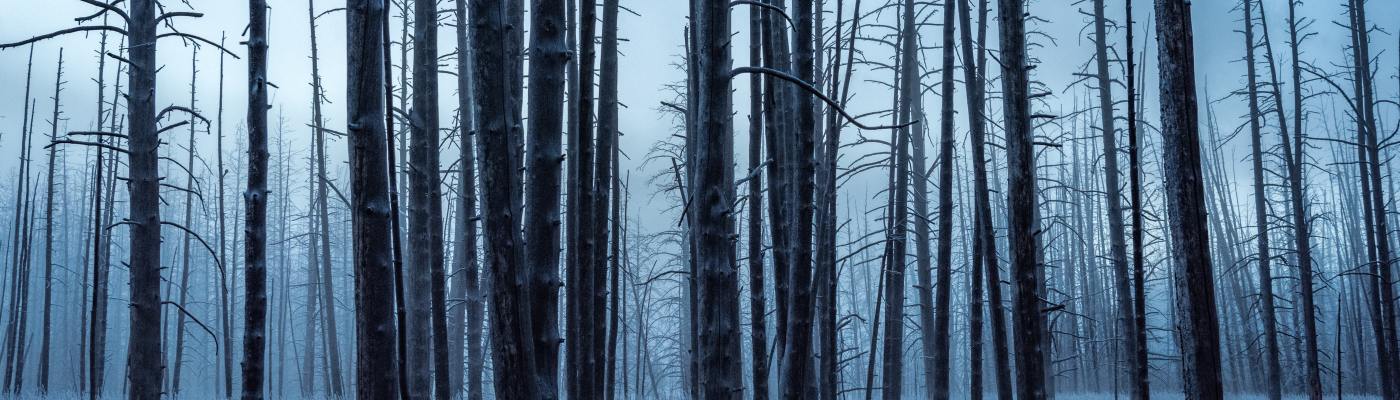
So where are we? In a spot of bleak scenery, where nature is a dead, empty, powerless personification of our senses. The descriptions point out everything that is missing. There is so much movement, but it is all hollow and impotent.
At last, there is a sound, a sense of life, but it too is a mirage, filled with a “single emptiness”–and also, not human. Still, there is a payoff to being here. We have reached “the last purity.” Maybe we have arrived at it. Or maybe we’ve run out of it.
Finally, we have this image of a malicious, rusty crow against a hard gray sky, landing on a branch. Why do you think he’s rusty? That old crow has been around a while, huh? And why the malice? Well…that old crow has been around a while, huh?
He is joined by another crow, which is almost a sign of comfort, but remember, there’s no comfort here. Stevens told us so at the beginning. So while the other crow joins the first, it is at a distance.
And that has to be enough for us.
Topics
desolation; death & dying; winter; relationships; social distancing 🙂
No Possum, No Sop, No Taters
He is not here, the old sun,
As absent as if we were asleep.
The field is frozen. The leaves are dry.
Bad is final in this light.
In this bleak air the broken stalks
Have arms without hands. They have trunks
Without legs or, for that, without heads.
They have heads in which a captive cry
Is merely the moving of a tongue.
Snow sparkles like eyesight falling to earth,
Like seeing fallen brightly away.
The leaves hop, scraping on the ground.
It is deep January. The sky is hard.
The stalks are firmly rooted in ice.
It is in this solitude, a syllable,
Out of these gawky flitterings,
Intones its single emptiness,
The savagest hollow of winter-sound.
It is here, in this bad, that we reach
The last purity of the knowledge of good.
The crow looks rusty as he rises up.
Bright is the malice in his eye . . .
One joins him there for company,
But at a distance, in another tree.
 stuckandmericle.com
One thought on “Day 29: No Possum, No Sop, No Taters by Wallace Stevens”